
Faculty In The News
April 2012 Jonathan Bloch
Information on research about the discovery of the world's largest snake premiered on a Smithsonian Channel special entitled “Titanoboa: Monster Snake.” A team co-organized by Dr. Jonathan Bloch, Florida Museum of Natural History Associate Curator of Vertebrate Paleontology and Associate Professor of Geological Sciences, Anthropology, and Zoology, and UF Geological Sciences PhD graduate and Smithsonian staff scientist Carlos Jaramillo found fossils of 28 snakes in a Colombian coal mine in 2004, but researchers did not realize they were snakes until 2007 because they were so large. The 48-foot-long, 2500-pound Titanoboa lived 58 million years ago. Other UF team members included Geological Sciences PhD candidate Alex Hastings, PhD student Aldo Rincon, and Biology PhD candidate (and Geological Sciences MS graduate) Fabiany Herrera. All appear on the show. The show was also broadcast on the Gainesville Television Network and can be seen online at http://www.smithsonianchannel.com/site/sn/show.do?show=140671#main.
Professor Mark Brenner appeared on PBS’s National Geographic special, “Quest for the Lost Maya." Archaeologists found evidence of previously unknown early Maya occupation hidden under an ancient pyramid in the Yucatan jungle. Structures included a huge palace complex. This ancient Maya community lacked nearby surface water sources and relied on rainwater stored in cisterns especially in the protracted dry season. The classic Maya abandoned the area around 900 AD without an obvious reason. Studying sediment cores taken from a lake 50 miles away, Brenner and colleagues Senior Associate In Geology Jason Curtis and former UF Geological Sciences Professor David Hodell (now at Cambridge University) discovered there had been a series of severe droughts, probably lasting from three to 20 years, including one that occurred coincident with the Maya departure from the area. Because the cisterns could store a limited water supply, it is believed drought forced the residents to leave. Political instability probably prevented their return. The special can be seen at http://www.pbs.org/programs/quest-lost-maya/.
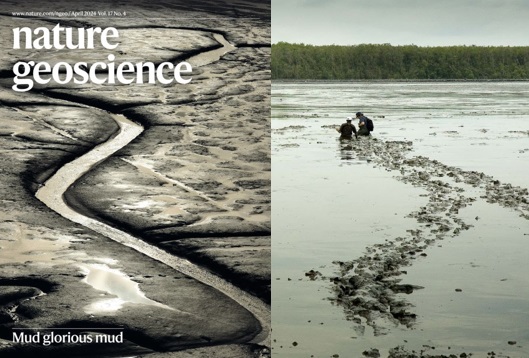
Distinguished Professor Dr. James E.T. Channell was quoted by the New York Times and the Voice of America suggesting, by analogy with previous ice ages, that the next ice age will be postponed indefinitely because of greenhouse gases in the atmosphere. Research by Channell and co-authors in the United Kingdom and Norway published in Nature Geoscience explains that the high current levels of carbon dioxide will prevent the natural cycle of cooling that would, in the absence of high carbon dioxide levels, cause the onset of the next ice age within 1500 years. The delayed cooling will result in melting of continental ice sheets and sea level rise. Comments on the study were also published by the Wall Street Journal, which interviewed Channell, and BBC News.
Associate Professor Dr. Joseph Meert was quoted in a Florida Times-Union story about the recent repainting of airport runway numbers at Jacksonville International Airport due to Earth's shifting magnetic field. The FAA requires runway numbers to match their magnetic compass headings, but those headings change due to magnetic north’s constant shift. This happens because the planet’s outer liquid core is always moving around its inner solid core, he explained. Other airports are also affected by this phenomenon.
Assistant Professor Dr. Andrea Dutton was interviewed by WCJB-TV20 about the satellite launched by NASA that morning. The National Polar-Orbiting Operational Environmental Satellite System (NPOESS) Preparatory Project (NPP) is a mission to collect and distribute remotely-sensed land, ocean, and atmospheric data to the meteorological and global climate change communities. She explained the types of data the satellite will collect, why it is important, and what it can tell us about ongoing climate change.
Assistant Professor Dr. Mark Panning discussed the department’s role in the Earthscope seismometer project on WUFT-FM. This project will locate seismometers every 42 miles throughout the United States. Third-year geology majors Guri Zeigerman and Marko Steiger contacted property owners in the area from the Florida Panhandle to Savannah, Georgia to obtain permission for underground seismometer placement on their land. The sensitive instruments will register major earthquakes worldwide, as well as record any local seismic activity.
July 2011 George Kamenov and Michael Perfit
An article by a team led by Associate In Geology Dr. George Kamenov and Professor and Chair Dr. Michael R. Perfit entitled “Ancient lithospheric source for Quaternary lavas in Hispaniola” was published online by Nature Geoscience. The article reports on their discovery of volcanoes near Hispaniola only one million years ago, much more recently than expected, and the surprising finding that the rock underlying the area has chemical characteristics similar to billion-year-old rock found under South and Central America more than 1,000 miles away. Kamenov discussed the research on WCJB-TV and was interviewed for an online article by OurAmazingPlanet.
Summer 2010 Ellen Martin
Reading Rocks: UF geologists travel back in time to understand what made Antarctica cold and what that tells us about climate change today
http://www.research.ufl.edu/publications/explore/current/story_2/
Florida's Swiss Cheese-Like Surface Rising
http://news.discovery.com/earth/florida-limestone-swiss-cheese.html
Geologist: Fla. ridges’ mystery marine fossils tied to rising land, not seas
http://news.ufl.edu/2010/06/01/florida-rise/
Marine geologist available to talk about research into rising sea levels
http://news.ufl.edu/2010/04/01/geologist-tip/
UF professor to help gauge future earthquake possibilities
http://news.ufl.edu/2010/03/10/chile-tip-russo/
Geologists push back date basins formed, supporting frozen Earth theory
http://news.ufl.edu/2008/07/03/old-rocks/
LUCKY BREAK GIVES SCIENTISTS UNIQUE VIEW OF UNDERWATER ERUPTION
http://earthobservatory.nasa.gov/Newsroom/MediaAlerts/
2006/2006112323736.html
Seafloor volcanic eruption recorded
http://washingtontimes.com/national/20061123-111738-1801r.htm
Opening the Door to a Chilly Climate Regime
http://www.sciencemag.org/cgi/content/full/312/5772/428
Getting to the Core of Climate Change
http://clasnews.clas.ufl.edu/news/alumninotes/05fall/climate.shtml
January 11, 2005 Ray G. Thomas, Jonathan B. Martin, and Kevin M. Hartl
Awarded United States Patent Number 6,840,121 for a "Self-Powered Fluid Sampler."
The automatic water sampler covered by this patent can be deployed directly in the water to be sampled opening up new sampling capabilities such as in large lakes, rivers, estuaries, vadose caves and water-filled conduits. The sampler consists of a pressure case, sample containers constructed of a spring-loaded syringe that is connected to solenoid valves, and electronics to control opening and closing the solenoid valves. Springs in the syringes remain compressed while the solenoid valve is closed. When the valve opens, the spring expands and draws water into the syringe. Once the syringe is filled, the solenoid valve closes, preserving the sample. The sampler is small, and easily transported and deployed. Some examples of hydrologic environments where it could be used include studies of hydrology of karst aquifers, water chemistry of lakes, and with modification, sampling of submarine ground water discharge to estuaries.
BARREN SIBERIA, OF ALL PLACES, MAY BE ORIGINAL HOME TO ANIMAL LIFE
http://sciencenow.sciencemag.org/cgi/content/full/2004/413/2
SUPERCONTINENT’S BREAKUP PLUNGED ANCIENT EARTH INTO BIG CHILL
http://www.sfgate.com/cgi-bin/article.cgi?f=/c/a/2004/03/18/
MNG8H5MU071.DTL&type=science